

Sharon panicked as Nick’s life was in danger due to a drug overdose Young And The Restless Spoilers
The neon lights of the Las Vegas strip have never felt further away than they do in the claustrophobic, concrete tomb where Nick Newman currently fights for his sanity. As of mid-April 2026, The Young and the Restless has officially abandoned the glitz of the high-roller tables for a gritty, psychological descent into a localized house of horrors. Nick Newman, the perennial “Golden Boy” and the moral anchor of his sprawling dynasty, woke up this week not to a ransom demand or a physical beating, but to a cold, sterile room illuminated by the flickering blue light of a high-definition monitor. The hunter has become the prey, as Matt Clark—the legendary demon of Nick’s past—reveals a masterstroke of villainy that transcends typical soap opera tropes. Matt isn’t interested in breaking Nick’s bones; he is hell-bent on shattering his soul through a relentless barrage of hidden-camera footage documenting Nick’s recent spiral into fentanyl addiction. The sight of the proud Newman heir reduced to a shivering captive, forced to watch his own lowest moments on a looping feed, is a visceral departure from the show’s traditional drama, marking a new, un-sanitized era where the greatest enemy isn’t a corporate rival, but the man in the mirror.
The sheer audacity of Matt Clark’s psychological warfare is designed to induce a state of total mental annihilation, stripping Nick of the “hero” narrative he has spent decades constructing. The grainy, irrefutable footage playing on the monitor captures every humiliating second of Nick’s downfall: the desperate drug deals, the slurred speech, and the agonizing moments of nodding off in the shadows of Sin City. Matt’s voice echoes through the speakers like a demonic narrator, mocking Nick’s “Golden Boy” image and emphasizing the cold truth that no one forced the pills down his throat. This is a masterclass in gaslighting and humiliation, as Matt forces Nick to confront the naked reality of his addiction without the comfort of denial. By broadcasting these images directly into Nick’s face, Matt is attempting to brand the character’s brain with his own failure

s, ensuring that even if Nick escapes the room, he will never escape the shame. The auditory backdrop of Matt’s laughter over the visuals of Nick’s drug-addled stumbling creates a sensory overload of pure misery, pushing the legacy character to a breaking point where his ego is effectively executed on screen.
While Nick suffers in his subterranean prison, the tragedy of his isolation is amplified by the absolute failure of his support system back in Genoa City. The Newman family is currently fractured by vanity and corporate ego-trips, leaving Nick to rot in a vacuum of abandonment. Victor Newman is states away, swiveling in his leather chair and obsessing over the Summers Conglomerate, while Victoria is on a pathetic “protect dad” tour, justifying her father’s worst impulses. Even Adam Newman, who was supposed to be his brother’s backup, has been completely neutralized by his own arrogance and the manipulative charms of Reza Thompson. Adam’s regression into his “Spider” persona has blinded him to the fact that his brother is dying ten feet away, creating a tragic narrative disconnect that leaves Nick entirely on his own. The irony is suffocating: the man who has always been the protector of others now has no one to protect him, forced to drown in a sea of fentanyl and self-loathing while his family plays corporate musical chairs.
The physical and mental toll of this “Locker Room Nightmare” has reduced Nick to the weakest person in the world, a shivering shell of a human being losing control of his bodily functions as withdrawal begins to set in. Joshua Morrow is currently delivering the performance of his career, portraying a man whose spirit has been fundamentally b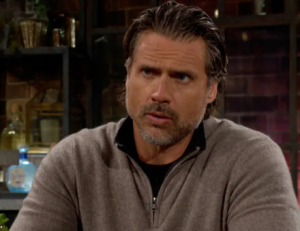 roken by the realization that his reputation is in ashes. Matt Clark’s endgame is not to commit murder, but to facilitate a suicide; he wants Nick to become so depressed and so consumed by the images on the screen that he chooses to drown in the drugs just to make the video stop hurting. The psychological torment is a “ticking time bomb” meant to induce a permanent overdose of shame. Nick is being forced to internalize every moment of weakness, watching himself betray his family and his own moral code until he questions if there is even a point to fighting for a life that feels already over. The walls are closing in, the loop never stops, and the stench of defeat is more overwhelming than the synthetic opioids coursing through his veins.
As the credits roll on this localized apocalypse, the future of the Newman family remains suspended in a state of clinical and spiritual uncertainty. The “Secret Footage” Matt holds is a nuclear weapon that could destroy the Newman legacy more effectively than any hostile takeover. Even if Nick survives the room and the drugs, he will emerge a changed man, scarred by the trauma of being his own worst enemy. This storyline suggests that hitting rock bottom is the only catalyst that could break through Nick’s stubborn Newman denial, but the cost of that clarity might be his very life. Whether he finds the strength to smash the screen or simply gives into the darkness remains the looming question that has the fan base in a state of collective anxiety. In a town where blood is thicker than water, Nick Newman has learned the hard way that blood is also the very thing the monsters are thirsty for. The “Golden Boy” has fallen, and as Matt Clark continues to smile into the camera lens, the only certainty is that the version of Nick we once knew has been definitively extinguished in a Vegas basement.