
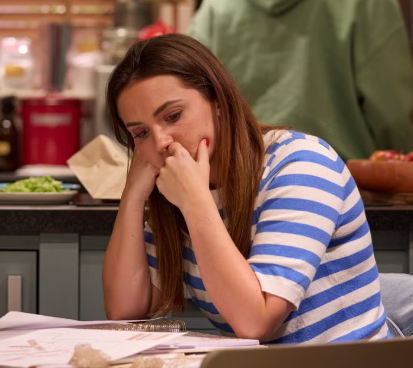
Emmerdale Confirms Disturbing New Gabby Storyline as Her Life Takes a Dangerous Turn
The deceptive tranquillity of Emmerdale has always been a fragile illusion, but the psychological storm quietly gathering around Gabby Thomas threatens to shatter the village with a devastating familiarity. For years, Gabby has clawed her way to a position of absolute authority, meticulously constructing an armor of fierce independence and unwavering control over her business, her family, and her romantic destiny. Yet, beneath the polished, self-assured veneer lies an emotional fault line that has recently been subjected to a series of catastrophic tremors. The initial catalyst appeared deceptively trivial: a brief, mortifying romantic rejection by Ross Barton, who had merely flirted with Gabby for the purely practical purpose of coaxing her into helping Sam Dingle refine his dance steps. Misinterpreting his charm as genuine, passionate interest, Gabby laid her heart bare only to be abruptly rebuffed, an embarrassing blunder that would be fleeting for most but has landed with nuclear force upon a soul already profoundly fractured. This humiliating encounter follows closely on the heels of the agonizing collapse of her engagement to Vinny Dingle after his world-altering revelation that he is gay—a trauma that forced Gabby to confront paralyzing questions about her own worth. Watching Vinny effortlessly pick up the pieces of his life and thrive while she suffocates under another layer of romantic failure has driven Gabby toward a perilous, isolating conclusion: that human vulnerability is a liability, and that complete, unyielding self-reliance is her only salvation.
What makes this impending spiral so uniquely chilling to witness is that Emmerdale is not charting unmapped territory; rather, the narrative is meticulously tapping into a deeply ingrained, cyclical pattern of self-destruction. Viewers with long memories will instantly recognize the dark, obsessive undercurrents that previously defined Gabby’s chaotic relationship with Nicky, but an even more terrifying precedent looms in her recent medical history. Prior to her ill-fated engagement party with Vinny, Gabby engaged in a silent, punishing battle with body dysmorphia—a harrowing ordeal born from an identical desperation for perfection that ultimately culminated in her emergency hospitalization. Because this psychological trigger mechanism is already hardwired into her psyche, her current onscreen choices carry a staggering weight of dramatic irony, transforming seemingly mundane lifestyle adjustments into flashing red alarms. The tragedy begins not with a dramatic breakdown or a screamed confession, but in the quiet, sterile margins of everyday routines where the true horror of a developing eating disorder takes root. The warning signs manifest during innocent dance rehearsals as Gabby rigidly declines chocolates from her supportive peers, substitutes meals with sterile protein bars, and pointedly swaps celebratory cocktails for ice-filled water. Individually, society praises these actions as hallmarks of dedication and health, but when the pursuit of physical wellness is weaponized to conquer emotional chaos, the boundary between self-improvement and life-threatening obsession vanishes entirely.
Desperate for a tangible arena where her grueling discipline can yield immediate, predictable dividends, Gabby rapidly shifts her hyper-focused gaze toward the daily operations of The Hide. In an inspired business move that initially garners widespread adoration, she orchestrates a radical overhaul of the establishment’s culinary identity, introducing a sleek menu dominated by clean, ultra-healthy options. The response from the local community is immediate and overwhelmingly ecstatic; compliments flood in, and for a woman bleeding from severe emotional rejection, this professional validation acts as a powerful, addictive narcotic. Unlike the volatile, unpredictable realm of human relationships where devotion can be met with betrayal or indifference, the strict mathematics of health, nutrition, and fitness offer Gabby a comforting illusion of absolute predictability. Rosie Bentham has masterfully highlighted this precise, agonizing complexity, forcing the audience to ponder the exact moment a commendable lifestyle focus degenerates into a catastrophic mental prison. Armed with the intoxicating high of public praise, Gabby begins spending hours submerged in the digital abyss of fitness influencers, extreme wellness algorithms, and restrictive dietary content. The digital landscape acts as an accelerant to her fragile state, gradually warping her perception through a relentless, algorithmic drip-feed of impossible physical standards, slowly mutating a simple quest for control into a full-scale psychological siege.
The true insidious horror of Gabby’s unfolding crisis lies in the absolute certainty that she will never cry out for salvation, trapped in a disorder that cloaks itself in the universally celebrated virtues of willpower and health. To the unsuspecting residents of the village, her accelerating weight loss is easily misconstrued as inspiring athletic dedication, and her intensely rigid eating habits are readily dismissed as the commendable discipline of a modern, successful businesswoman. This societal blind spot allows the early, critical phases of her relapse to remain completely invisible to the family and friends who love her most, as Gabby herself genuinely believes she is merely ascending to a higher plain of personal achievement. The dramatic tension thickens with every scene, creating a suffocating sense of dread for the audience who can clearly see the historical trajectory of the path she is walking, knowing with absolute certainty where this road terminates. It is a slow-motion car crash fueled by digital echo chambers and personal grief, where every calculated calorie and skipped meal represents a desperate, silent scream for the control that Ross Barton and Vinny Dingle unwittingly stripped away from her.

As the narrative engine of Emmerdale accelerates toward a boiling point, the central enigma of the storyline shifts away from Gabby’s motives—which are already tragically transparent—and fixes squarely on the oblivious community surrounding her. The heartbreaking reality of her situation is that the very tools she is using to heal her fractured ego are systematically dismantling her physical and psychological survival, creating a ticking time bomb wrapped in the guise of wellness. With every passing episode, the illusion of control she so desperately craves slips further into a dictatorship of deprivation, leaving her increasingly isolated within the fortress of her own design. The haunting question that now dictates the future of this heavy-hitting storyline is whether anyone in her inner circle will possess the profound intuition to peer beneath her successful facade and diagnose the agony within before history catastrophically repeats itself. If they fail to intervene, the consequences will far exceed the heartbreak of a broken engagement or a rejected advance; it will become a battle for Gabby’s very survival, proving that the most dangerous predators in the village are not always the villains who walk the streets, but the silent obsessions that feed on our deepest insecurities.